
A voice cloning scam is when criminals use AI to copy the voice of someone you love, then call you with a fake emergency and ask for money fast. To protect yourself, hang up and call the person back on a number you know, set up a family safe word, and be suspicious of any call that demands gift cards, wire transfers or crypto.
Below are nine easy ways to spot and stop AI voice scams, plus what to do if you’ve already been targeted.
[ADD PERSONAL EXPERIENCE: one line about whether you or someone you know has received a suspicious “family emergency” call.]
Table of Contents
What Is a Voice Cloning Scam?
Voice cloning is using AI to create a realistic copy of someone’s voice. The technology has good uses, like helping people who’ve lost their voice. But scammers use it to impersonate family members, bosses and even celebrities.
The most common version is the “family emergency” or “grandparent” scam. You get a call that sounds exactly like your child, grandchild or partner. They’re crying, scared, and say they’ve been in an accident or arrested. Then someone else, a fake lawyer or police officer, comes on the line to ask for money.
How the Scam Works
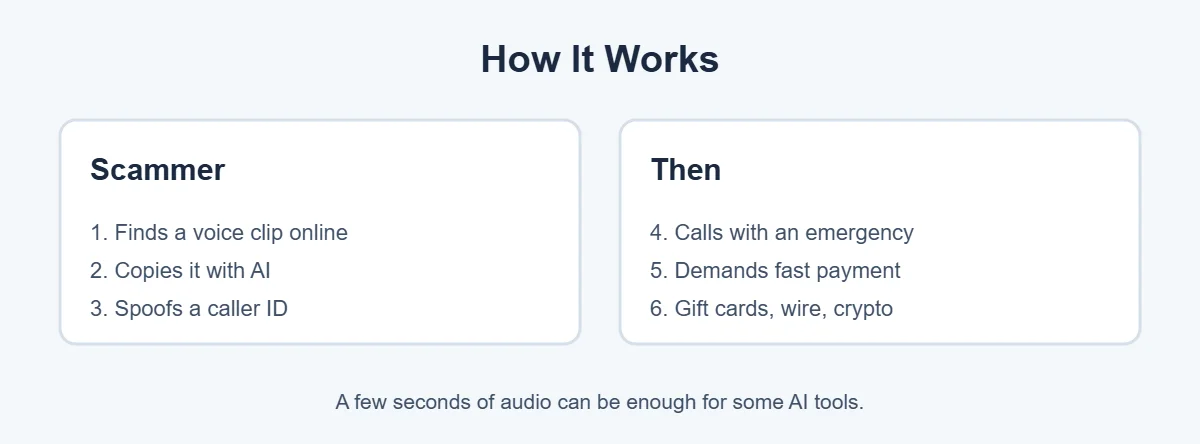
- They find a voice sample from social media videos, voicemail greetings or public posts.
- They copy the voice with AI tools. Some can make a believable clone from a few seconds of audio.
- They spoof the caller ID so the call looks like it’s from a local or familiar number.
- They create panic with an emergency story.
- They demand fast payment in ways that are hard to trace or reverse.
Warning Signs of an AI Voice Scam
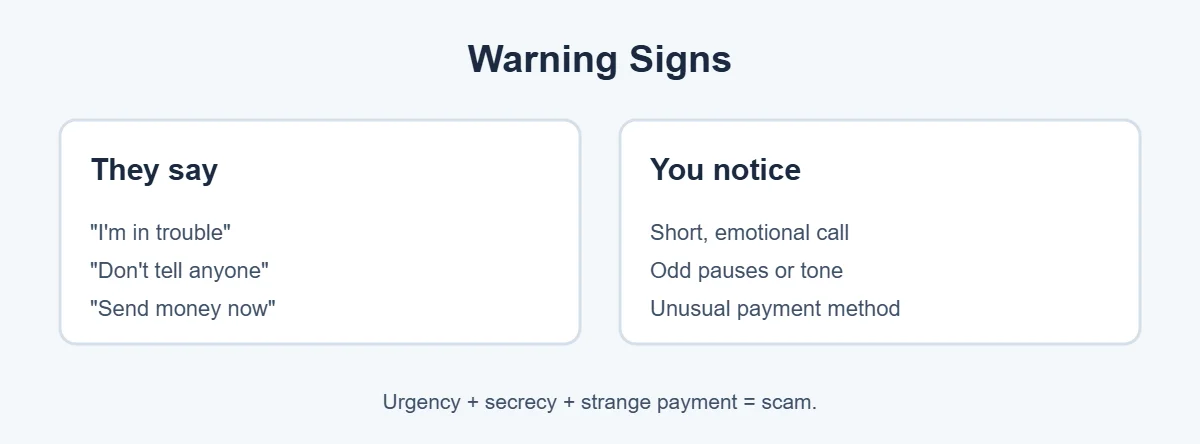
- Urgency: “I need money right now.”
- Secrecy: “Don’t tell Mom and Dad” or “Don’t call anyone.”
- Strange payment: gift cards, wire transfers, crypto, or cash pickup by a courier.
- Short calls: the “relative” speaks briefly, then hands the phone to someone else.
- Something feels off: odd pauses, flat emotion, or they don’t answer personal questions well.
- Unknown number: “My phone broke, I’m calling from a friend’s.”
9 Easy Ways to Stop a Voice Cloning Scam
1. Hang up and call back
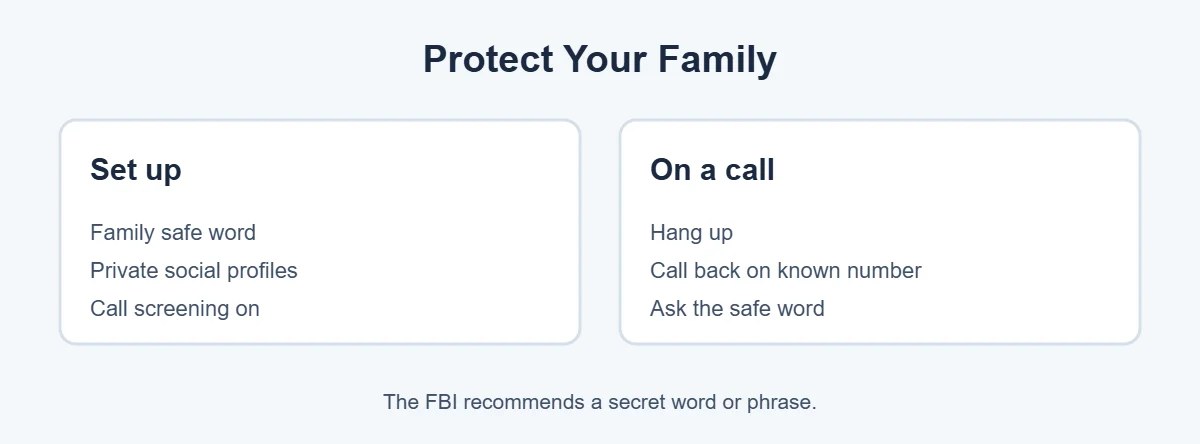
This is the single best defense against a voice cloning scam. End the call and call your relative on the number you already have saved. If you can’t reach them, call another family member.
2. Set up a family safe word
Pick a secret word or phrase that only your family knows, and never post it online. The FBI has recommended creating a secret word or phrase to verify family members.
3. Ask a personal question
Ask something a scammer couldn’t find online, like the name of a childhood pet or what you ate together last weekend.
4. Never pay with gift cards, wire or crypto
Real lawyers, police and hospitals don’t ask for payment in gift cards or crypto. That request alone means it’s a scam.
5. Slow down
Scammers rely on panic. Take a breath. A real emergency can wait two minutes while you check.
6. Turn on call screening
On iPhone with iOS 26, use Screen Unknown Callers. On Android, turn on spam filtering and Call Screen where available. Many scam calls never reach you.
7. Make social media private
Limit who can see videos where you or your kids speak. Fewer public clips mean less audio for scammers.
8. Change your voicemail greeting
Use the default greeting or a short one without your name. A long personal greeting can give scammers a voice sample.
9. Talk to older relatives
Explain the scam to parents and grandparents, set up the safe word together, and tell them it’s always okay to hang up and call you.
Is It Legal?
In the US, the FCC ruled in February 2024 that robocalls using AI-generated voices fall under existing robocall rules, making them illegal without consent. Impersonation for fraud is a crime in most countries. But laws don’t stop determined scammers, so your own habits matter most.
For more simple guides, visit TrickieTech.
Other Types of Voice Cloning Scam
| Scam | Who they pretend to be | What they want |
|---|---|---|
| Family emergency | Child, grandchild, partner | Bail, hospital or lawyer money |
| Boss or CEO fraud | Your manager or company director | Urgent wire transfer or gift cards |
| Bank fraud team | Your bank, using a calm “agent” voice | Codes, PINs or a transfer to a “safe account” |
| Fake kidnapping | A crying relative and a “kidnapper” | Ransom paid fast |
| Celebrity or politician | Famous voice in a robocall or video | Investments, donations or votes |
Voice Cloning Scam at Work
A voice cloning scam can target businesses too. A finance worker gets a call or video meeting that seems to be the boss, asking for an urgent payment to a new supplier. To protect a business:
- Require a second person to approve large or unusual payments.
- Always confirm payment changes by calling a known number, not the one in the message.
- Agree on a verification phrase for urgent requests from leaders.
- Train staff that voices and even video can be faked.
What to Do During a Suspicious Call
- Stay calm and don’t agree to anything.
- Ask for the safe word or a personal question.
- Say you’ll call back, then hang up.
- Call your relative on their saved number, or someone who’s with them.
- Don’t share personal details like addresses, account numbers or codes.
- Write down the number, time and what they said, for your report.
What to Do If You Already Paid
- Gift cards: call the gift card company using the number on the back of the card. Ask them to freeze the funds. Keep the cards and receipts.
- Bank or wire transfer: call your bank immediately and ask for a recall.
- Payment apps: report the payment as fraud in the app and contact your bank.
- Crypto: report to the exchange you used. Recovery is hard, so act quickly.
- Cash by courier: call the police, especially if the courier may return.
Then report the voice cloning scam: in the US at ReportFraud.ftc.gov and the FBI’s IC3, in the UK to Action Fraud, in Canada to the Canadian Anti-Fraud Centre, and in Australia to Scamwatch.
Protect Your Own Voice
- Keep social media accounts private, especially kids’ accounts.
- Think twice before posting long videos of you talking.
- Be careful with calls that ask you to say “yes” or repeat phrases.
- Don’t use voice-only verification for bank accounts if you can choose a stronger option.
Real-Life Examples
“My grandson called crying from jail”
The grandmother hung up and called her grandson’s mobile. He was at school, safe. The call was a voice cloning scam using clips from his public videos.
“My boss asked me to buy gift cards urgently”
It was a voice cloning scam. The employee called the boss’s desk number to check. The boss had made no such request.
[ADD PERSONAL EXPERIENCE: add a short real example if you have one.]
Simple Words You’ll See
- Voice cloning: using AI to copy a person’s voice.
- Deepfake: AI-made fake audio, images or video of a real person.
- Caller ID spoofing: faking the number that shows on your screen.
- Safe word: a secret word your family uses to confirm who’s calling.
- Vishing: scams done by voice call.
Quick Checklist
- Set a family safe word today.
- Hang up and call back on a known number.
- Never pay with gift cards, wire or crypto.
- Turn on call screening.
- Make social media private.
- Use a simple voicemail greeting.
- Talk to older relatives about the scam.
- Report any scam call.
How to Choose a Good Family Safe Word
A safe word only works against a voice cloning scam if it’s easy to remember and impossible to guess. Tips:
- Pick something random and silly, like “purple pancake” or “rusty kettle.” Avoid pet names, birthdays or street names, which can be found online.
- Share it in person, not by text or social media.
- Make sure everyone knows it, including grandparents, teens and the babysitter.
- Practice it. Ask for it now and then during normal calls so it becomes a habit.
- Change it if you think someone outside the family learned it.
Video Deepfakes: The Next Step
Scammers are moving from voice to video. A fake video call might show a face that looks like a relative or a manager. The same rules apply: be suspicious of urgent money requests, ask the safe word or a personal question, and hang up to call back on a known number. Watch for signs like blurry edges around the face, lips slightly out of sync with the words, or a call that suddenly “freezes” when you ask a question.
Why These Scams Work
A voice cloning scam works because it targets feelings, not logic. Hearing someone you love in distress triggers fear and the urge to help immediately. Scammers add pressure with time limits and secrecy so you don’t stop to think. Knowing this ahead of time is powerful. If you ever feel panic during a call about money, treat that feeling as your signal to pause, hang up and check.
Teach Kids and Teens About Voice Scams
A voice cloning scam can involve teens too. Young people post lots of videos, which gives scammers voice samples, and they can also be targeted with fake calls from “parents.” Have a short, calm conversation:
- Explain that AI can copy voices, so a familiar voice isn’t proof.
- Teach them the family safe word and that you’ll always ask for it in an emergency.
- Ask them to keep accounts private and avoid posting long talking videos publicly.
- Tell them they won’t get in trouble for hanging up and calling you back.
What Phone Companies and Banks Are Doing
Carriers in the US, UK, Canada and Australia are adding more scam call filtering, and many banks now warn customers before large or unusual transfers. Some banks add a short delay or extra questions when you send money to a new person. These protections help, but they can’t catch every voice cloning scam. If your bank asks “Has anyone told you what to say?”, answer honestly. That question exists because scammers often coach victims.
Check What’s Public About You
Search your own name and your children’s names online, and look at what videos and personal details appear. Remove public videos you don’t need, tighten privacy settings, and ask family not to tag kids in public posts. Less public information makes it harder for scammers to build a believable story.
Can Apps Detect AI Voices?
Some security companies and phone makers are testing tools that try to detect AI-generated voices during calls. They may help in the future, but none are perfect today, and scammers keep improving their tools. Don’t rely on an app to tell you whether a voice is real. Rely on your process instead: pause, verify with a call back or safe word, and never send money under pressure.
Think of it like a fire drill. When everyone in your family knows the steps in advance, a voice cloning scam loses most of its power, because nobody acts on panic alone.
A Simple Script for the Next Suspicious Call
If you ever suspect a voice cloning scam, keep these words in mind, or write them on a note by the phone, so you know exactly what to say:
“I’m going to hang up and call you right back on your usual number. If this is real, you’ll understand.”
Then hang up, even if the caller begs or gets angry. Call your loved one directly. A real family member will be relieved you checked. A scammer will usually never call back, because they know their trick has failed.
Frequently Asked Questions
What is a voice cloning scam?
A voice cloning scam is when criminals use AI to copy someone’s voice, often from videos posted online, then call a family member pretending to be that person. They usually describe an emergency, like an arrest or accident, and ask for money fast through gift cards, wire transfers or crypto.
How can I tell if a voice on the phone is AI?
It’s getting harder to hear the difference. Instead of judging the voice, judge the situation: urgency, secrecy, and unusual payment requests are big warning signs. Hang up and call the person back on a number you know, or ask a question only they could answer, like your family safe word.
How much audio do scammers need to clone a voice?
Some AI tools can make a convincing copy from just a few seconds of clear speech, though longer clips usually sound better. Videos on social media, voicemail greetings and recorded calls can all give scammers enough audio to work with.
What is a family safe word?
A family safe word is a secret word or phrase that only your family knows. If someone calls claiming to be a relative in trouble, ask for the word. A scammer won’t know it. The FBI recommends this simple step to protect against AI voice scams.
Are AI voice robocalls illegal?
In the US, the FCC ruled in February 2024 that robocalls using AI-generated voices fall under existing robocall rules, making them illegal without the called person’s prior consent. Scammers ignore the law, so you still need to protect yourself.
What should I do if I sent money to a voice scammer?
Contact your bank, card company, gift card company or wire service straight away and ask them to stop or reverse the payment. Report the scam to the FTC at ReportFraud.ftc.gov in the US, or Action Fraud in the UK. Keep records of the call and payment.
The Bottom Line
A voice cloning scam can sound exactly like someone you love, so don’t trust the voice, trust the situation. Urgency, secrecy and strange payment requests mean scam.
Hang up and call back on a known number, set up a family safe word today, and never send gift cards, wire transfers or crypto to someone who calls you.
{“@context”:”https://schema.org”,”@type”:”FAQPage”,”mainEntity”:[{“@type”:”Question”,”name”:”What is a voice cloning scam?”,”acceptedAnswer”:{“@type”:”Answer”,”text”:”A voice cloning scam is when criminals use AI to copy someone’s voice, often from videos posted online, then call a family member pretending to be that person. They usually describe an emergency, like an arrest or accident, and ask for money fast through gift cards, wire transfers or crypto.”}},{“@type”:”Question”,”name”:”How can I tell if a voice on the phone is AI?”,”acceptedAnswer”:{“@type”:”Answer”,”text”:”It’s getting harder to hear the difference. Instead of judging the voice, judge the situation: urgency, secrecy, and unusual payment requests are big warning signs. Hang up and call the person back on a number you know, or ask a question only they could answer, like your family safe word.”}},{“@type”:”Question”,”name”:”How much audio do scammers need to clone a voice?”,”acceptedAnswer”:{“@type”:”Answer”,”text”:”Some AI tools can make a convincing copy from just a few seconds of clear speech, though longer clips usually sound better. Videos on social media, voicemail greetings and recorded calls can all give scammers enough audio to work with.”}},{“@type”:”Question”,”name”:”What is a family safe word?”,”acceptedAnswer”:{“@type”:”Answer”,”text”:”A family safe word is a secret word or phrase that only your family knows. If someone calls claiming to be a relative in trouble, ask for the word. A scammer won’t know it. The FBI recommends this simple step to protect against AI voice scams.”}},{“@type”:”Question”,”name”:”Are AI voice robocalls illegal?”,”acceptedAnswer”:{“@type”:”Answer”,”text”:”In the US, the FCC ruled in February 2024 that robocalls using AI-generated voices fall under existing robocall rules, making them illegal without the called person’s prior consent. Scammers ignore the law, so you still need to protect yourself.”}},{“@type”:”Question”,”name”:”What should I do if I sent money to a voice scammer?”,”acceptedAnswer”:{“@type”:”Answer”,”text”:”Contact your bank, card company, gift card company or wire service straight away and ask them to stop or reverse the payment. Report the scam to the FTC at ReportFraud.ftc.gov in the US, or Action Fraud in the UK. Keep records of the call and payment.”}}]}