
If someone calls claiming to be from the Federal Trade Commission and says your phone number is linked to fraud in another country, hang up. That FTC scam call is fake: the real FTC never calls to deactivate your number, never asks for money, and never tells you to keep a conversation secret. The agency warned about this exact script in a consumer alert on October 22, 2026.
This FTC scam call is built to scare you fast. It starts with a “badge number,” moves to a fake police officer, and ends with a demand for a “security deposit” to avoid arrest. This guide shows how the script works, how to spot it in the first minute, and exactly what to do if you already talked to the caller or sent money.
Information current as of November 6, 2026. Scam scripts change quickly, so check the FTC’s consumer alerts page for the latest version.
What is the FTC phone number deactivation scam?
The FTC phone number deactivation scam is a government impersonation scam delivered by an FTC scam call. A caller pretends to work for the Federal Trade Commission and claims a phone line registered in your name is being used for scams abroad. The goal is to collect your ID and personal details, then pressure you into paying money to “clear” your name.
A government impersonation scam is any scheme where a criminal poses as a real agency (FTC, IRS, Social Security, Medicare, police) to get money or information. These scams work because people trust official titles and fear legal trouble.
The FTC described this version in its alert “The FTC is not calling to deactivate your phone number” (October 22, 2026). News outlets including Popular Science and Bitdefender reported the same pattern in late October and early November 2026.
How the FTC scam call works, step by step
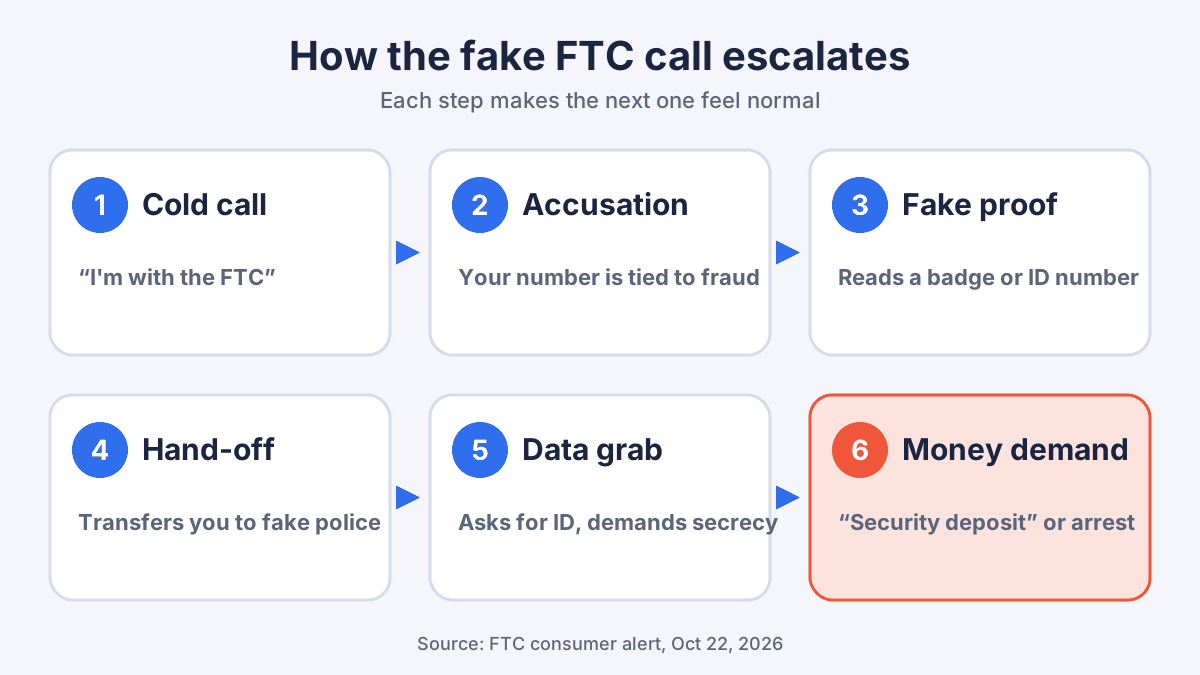
Every FTC scam call in this wave follows a similar escalation. Each step is designed to make the next one feel normal.
- The cold call. Someone says they are an FTC official. Caller ID may look official, but caller ID can be faked.
- The accusation. They claim a phone was registered with your name and number and is being used for fraud in another country.
- The “proof.” They read you a badge or employee ID number. It is fake.
- The threat. If you hesitate, they say your phone number will be deactivated.
- The handoff. They “transfer” you to a police officer to file a report. That officer is part of the scam.
- The fake verification. If you push back, they tell you to look up the police department’s number online and tell you what to search for. The number you find leads back to the scammers.
- The data grab. The “officer” asks for your state ID and personal details “for the report” and tells you to keep everything secret.
- The money demand. A later call says you are under arrest and must travel to another country unless you send a “security deposit.”
The FTC’s own summary of this FTC scam call is blunt: “None of this is true — it’s all a scam.”
5 red flags you can spot in the first minute
You can end an FTC scam call long before money comes up. These are the signs the FTC lists as things a real employee will never do, plus warning signs from its general government impersonation guidance.
| What the caller does | What the real FTC does |
|---|---|
| Threatens to disconnect or deactivate your phone | Never threatens to disconnect your phone |
| Asks you to send money or a “security deposit” | Never asks you to send money |
| Tells you to keep the call secret | Never asks for secrecy |
| Texts a photo of an “employee ID” to prove who they are | Never texts badge photos to verify identity |
| Wants payment by wire, gift card, crypto or payment app | No government agency demands payment this way |
Two more tells are easy to miss. First, the FTC does not handle individual phone lines at all; phone service belongs to your carrier. Second, the FTC does not transfer callers to police departments or tell you to look up a number while you stay on the line.
What to do during the call
The safest response to any FTC scam call is to hang up without arguing. You do not need to prove the caller is fake, and every extra minute gives them more chances to pull details from you.
- Hang up. Don’t press any number, even one that promises to “remove you from the list.”
- Don’t confirm anything. Avoid saying your full name, address, date of birth or the last four digits of your Social Security number.
- Don’t call back numbers they give you, or numbers they tell you to search for. Look up contact details yourself on an official .gov site.
- Don’t send photos of your ID or passport to anyone who contacted you first.
- Talk to someone you trust. Scammers rely on secrecy. Telling a family member breaks the pressure.
[ADD PERSONAL EXPERIENCE: Describe a time you or a reader got a "government" call. What did the caller say first, and what made you suspicious? One real example here builds trust.]
Already talked to them? What to do next
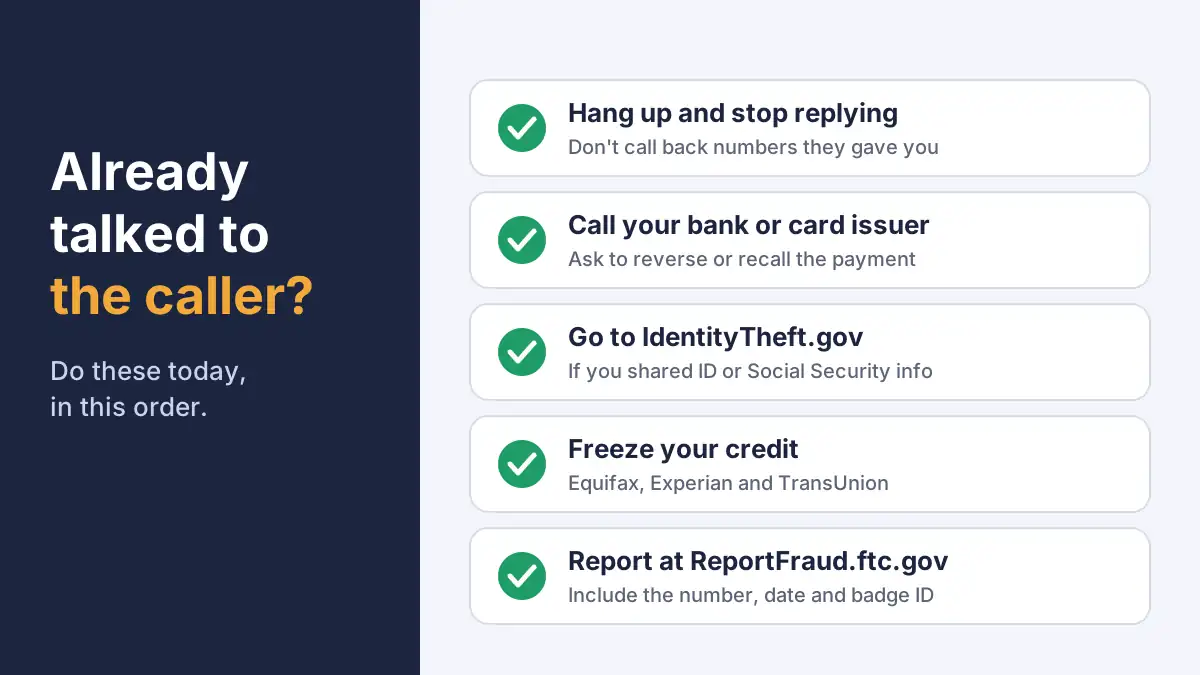
If you shared information or paid money after an FTC scam call, act today. Speed matters most with bank transfers and gift cards, which are hard to reverse once the money moves.
If you gave personal information or ID photos
- Go to IdentityTheft.gov and follow the steps for the exact details you shared (ID, Social Security number, bank info).
- Place a free fraud alert or credit freeze with the three credit bureaus (Equifax, Experian and TransUnion). A freeze stops new accounts from being opened in your name.
- Watch your bank statements and email for password-reset messages you did not request.
If you sent money
- Bank transfer or wire: call your bank right away using the number on your card or statement. Ask them to reverse or recall the transfer.
- Gift cards: contact the company that issued the card, tell them it was used in a scam and ask for a refund. Keep the card and receipt.
- Payment app: report the transaction in the app and to the bank or card linked to it.
- Cryptocurrency: contact the exchange or the company you used to send it. Recovery is rare, so report quickly.
Report the call
- FTC: ReportFraud.ftc.gov. Reporting every FTC scam call helps the agency track the script and warn others.
- Your state attorney general: find yours through the National Association of Attorneys General.
- Your phone carrier: if the scammer actually got your account PIN or ID, call your carrier and add a port-out or number-lock protection.
After an FTC scam call, be wary of anyone who later calls offering to “recover” your lost money for a fee. Recovery scams often target people who were just scammed.
How big is the FTC scam call problem?
Government impersonation is one of the costliest scam types in the US. According to an FTC press release dated June 15, 2026, people reported losing \$3.5 billion to imposter scams in 2025, and about \$920 million of that involved government impersonators, up from \$789 million in 2024.
The same release says total reported fraud losses reached about \$16 billion in 2025, the highest on record. Imposter scams were the most reported fraud category, making up nearly one in three fraud reports. These are only reported losses; many victims never file a report, so the real numbers are likely higher.
How to cut down on scam calls going forward
You can’t stop every FTC scam call, but you can make them rarer and easier to ignore.
- Turn on your phone’s built-in call screening. On iPhone, Silence Unknown Callers or Call Screening sends unknown numbers to voicemail or asks callers to say who they are. Most Android phones offer a similar spam filter in the Phone app.
- Use your carrier’s free spam blocking. AT\&T, Verizon and T-Mobile all offer free scam-call labeling or blocking tools.
- Lock your number with your carrier. A number lock or port-out PIN makes SIM-swap fraud harder if a scammer gets your details.
- Agree on a family rule. No one sends money or ID because of an unexpected call, no matter who it claims to be from, without hanging up and checking first.
Frequently asked questions
Does the FTC call people about their phone number?
No. The FTC does not call people to deactivate, suspend or investigate their phone number. Phone service is run by carriers, not the FTC. If someone calls claiming to be from the FTC and mentions your phone line, it is an FTC scam call. Hang up and report it at ReportFraud.ftc.gov.
Can the FTC deactivate my phone number?
No. The FTC has no power to switch off your phone line. Only your mobile carrier can suspend your service, and it would contact you through your account, not through a government official. Threats to “deactivate” your number are the core pressure tactic of the FTC scam call, used to rush you into handing over information or money.
Is it a scam if the caller gives me a badge number?
Yes, a badge number proves nothing. Scammers read fake badge or employee ID numbers to sound official, and some even text a photo of a fake ID. The FTC says its employees will never text an ID photo to verify themselves. Look up the agency’s real number yourself on its .gov website.
What should I do if I gave a scammer my ID?
Go to IdentityTheft.gov and follow the recovery plan for the documents you shared. Place a fraud alert or credit freeze with Equifax, Experian and TransUnion, and watch your accounts closely. Report the call at ReportFraud.ftc.gov. If you shared bank details, call your bank right away using the number on your card.
How do I report an FTC impersonation scam?
Report it to the FTC at ReportFraud.ftc.gov. You can also file a complaint with your state attorney general. Include the phone number that called, the date and time, the name and badge number the caller used, and any payment details. Your report helps law enforcement spot patterns and warn other people.
Can I get my money back after a scam call?
Sometimes, if you act fast. Call your bank immediately for wire or bank transfers, contact the gift card company for gift cards, and report payment-app transactions in the app. Cryptocurrency is rarely recovered. Ignore anyone who calls offering to recover your money for a fee; that is often a second scam.
The bottom line
An FTC scam call claiming your number is tied to fraud abroad is always fake. The real FTC won’t threaten your phone line, ask for secrecy, demand a deposit, or send you to a “police officer” on the same call. Hang up, verify through an official .gov site, and report the call at ReportFraud.ftc.gov. If you already shared details or money, call your bank and visit IdentityTheft.gov today. Then share this with older relatives, who are frequent targets of government impostors.
