
The Cleverbridge data breach is a November 2026 security incident in which an outside party copied payment card details from Cleverbridge, a company that runs online checkout for many software brands. If you bought software or a subscription online and got a letter about it, check your card statements, ask your bank for a new card and ignore anyone who calls asking for card details.
You may never have heard the name Cleverbridge before the Cleverbridge data breach, yet it may still have handled your payment. That is why so many people were confused when the notification letters arrived. This guide explains what was taken, how to tell if you are affected and the exact steps to take this week.
Last updated: November 24, 2026. Details are still coming out, so check back as the investigation continues.
Table of contents
- What happened in the Cleverbridge data breach?
- What is Cleverbridge, and why did it have my card?
- What data was exposed?
- How do I know if I’m affected?
- What to do after the Cleverbridge data breach: 7 steps
- Scams to watch for after the breach
- Cleverbridge data breach FAQ
What happened in the Cleverbridge data breach?
On November 4, 2026, Cleverbridge detected unauthorized activity on its systems, took the affected systems offline and brought everything back the same day. Its investigation found that a third party had copied some personal data, including payment card details used for purchases made through the platform.
Here is the Cleverbridge data breach timeline as of November 24, 2026:
| Date (2026) | What happened |
|---|---|
| November 4 | Cleverbridge detects unauthorized activity, takes systems offline and restores them the same day |
| November 20 | Notification letters start going out to affected cardholders |
| November 22–23 | Security news sites, including Help Net Security and Security Affairs, report on the notice |
| Now | Investigation still ongoing; no count of affected people published |
Cleverbridge says this was not ransomware. In its own words on the official incident update page, “None of our systems were encrypted.”
What we still don’t know: how the attacker got in, how long they had access before detection and how many cardholders were affected. Cleverbridge has also not named which of its client companies had customers involved.
What is Cleverbridge, and why did it have my card?
Cleverbridge is a global e-commerce company that runs checkout, payments and subscription billing for software and online service businesses. When you buy a license or renew a subscription from one of its clients, Cleverbridge often acts as the “merchant of record,” which means it processes the charge for that brand.
This is why the Cleverbridge data breach surprised people: the name on your card statement may not match the product you bought. For example, the Malwarebytes help page on its billing lists Cleverbridge among the companies that process cards on its behalf, with statement entries such as “CBI*MALWAREBYTES” or “www.cleverbridge.net.”
Security Affairs and Help Net Security report that companies listed as Cleverbridge clients on its website include Red Hat, SUSE, Sony, Veeam, Tenable, Jamf and Parallels. Being a client does not mean a company’s customers were affected; Cleverbridge has not said which were.
[ADD PERSONAL EXPERIENCE: Check your own card statements for any “CBI*”, “CBA*” or “cleverbridge” entries and describe what you found and which product it was for.]
What data was exposed in the Cleverbridge data breach?
The exposed data is mainly payment card information. Cleverbridge’s official page says the data may include card details used for a purchase through its platform, and that “in a minority of cases, this information included CVV data.”
According to the notice obtained by BleepingComputer and summarized by Help Net Security, the copied data can include:
- Card number (the full long number on the front of the card)
- Expiration date
- CVV or CVC code (the three- or four-digit security code), in some cases
A CVV is the short security code printed on your card that online stores use to check you have the physical card. Merchants are generally not supposed to keep it after a purchase, which is why its presence in this incident drew attention. Security Affairs notes that reporters asked Cleverbridge why the codes were accessible at all.
Help Net Security reports the letter says names, contact details and billing details were not copied. However, one security news tracker cited a notice listing emails, billing addresses and phone numbers as possibly exposed. Until this is settled, assume your email and phone number could be in the wrong hands.
Why a card number plus CVV matters
A card number, expiry date and CVV together, as exposed in the Cleverbridge data breach, are enough to try many online purchases. That is why replacing the card is the safest move, rather than just watching your statement.
How do I know if I’m affected by the Cleverbridge data breach?
You are most likely affected if you received a notification letter or email about the incident, which began arriving on November 20, 2026. The letters are being sent on Cleverbridge’s behalf by TransUnion’s Cyberscout service, so the sender name may not say Cleverbridge.
If you didn’t get a letter, run these quick checks:
- Search your card statements for “cleverbridge,” “CBI*” or “CBA*” over the last two years.
- Search your email for “cleverbridge” to find old receipts. Software receipts often name it as the reseller.
- Use the Cleverbridge purchase lookup linked from its incident page to find orders tied to your email.
- Think about software you buy online: antivirus, backup tools, VPNs, design apps and developer tools are common Cleverbridge categories.
If none of these turns anything up, the Cleverbridge data breach probably didn’t affect you. Still, it’s a good moment to check whether your email has shown up in other data breaches.
What to do after the Cleverbridge data breach: 7 steps
The most important step is to replace any card you used through Cleverbridge, because a stolen card number with its CVV can be used for online fraud. Then watch your accounts and stay alert for scam calls. Here is the full order of steps.
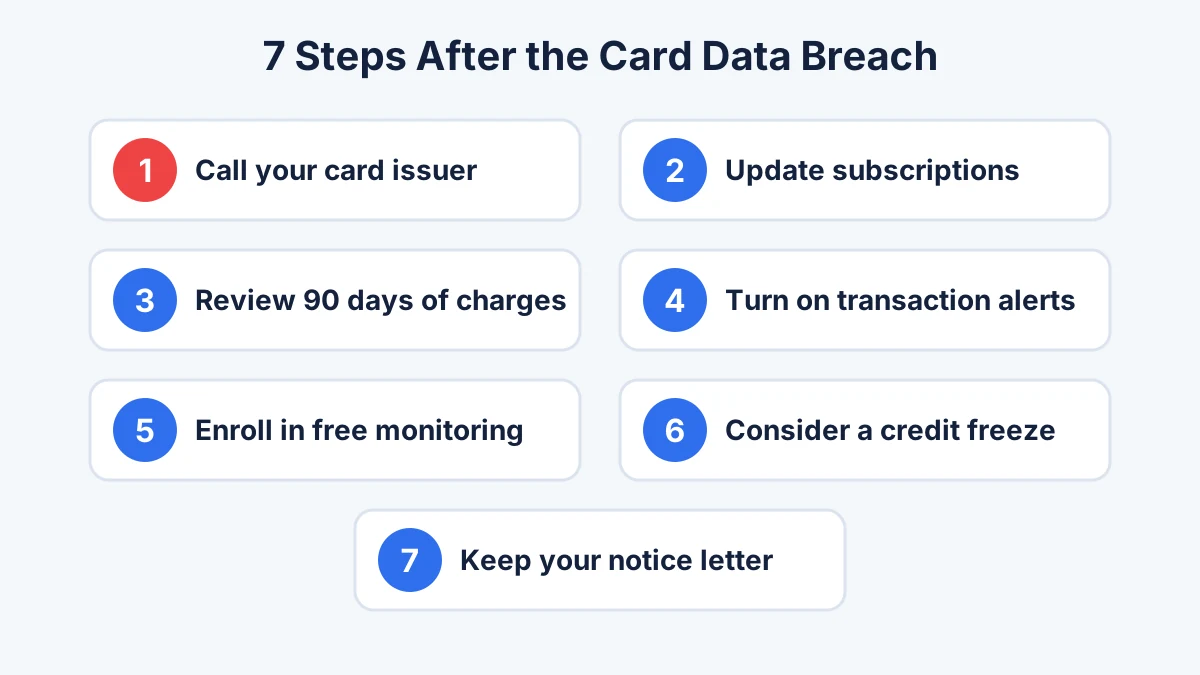
- Call your card issuer and request a new card. Use the number on the back of your card. Say the card may have been exposed in the Cleverbridge data breach. Most banks issue a new number for free.
- Update your subscriptions. A new card breaks auto-renewals. Update your payment details in the vendor’s own account page, not through links in emails.
- Review the last 90 days of transactions. Look for small “test” charges of a dollar or two, which fraudsters use to check a card works. Dispute anything you don’t recognize.
- Turn on transaction alerts. Set your banking app to notify you of every card purchase, so fraud shows up within minutes.
- Enroll in the free monitoring offer. Cleverbridge says it has offered credit or identity monitoring “where available.” The enrollment code is in your letter.
- Consider a credit freeze. Card theft alone doesn’t let someone open new accounts, but a free freeze at Equifax, Experian and TransUnion blocks that risk if more personal data turns out to be exposed. The FTC explains how freezes work.
- Keep your letter. It contains your enrollment code and may matter if a class action or settlement follows.
Debit card vs credit card: which is riskier?
A debit card is riskier because fraud pulls money straight from your bank account until it’s sorted out. Under federal rules, credit card fraud liability is capped at $50, and most issuers charge nothing. If the exposed card is a debit card, replace it first.
| Card type | Where stolen money comes from | Typical liability | Priority |
|---|---|---|---|
| Credit card | The bank’s credit line | $0–$50 | Replace soon |
| Debit card | Your checking account | Depends on how fast you report | Replace today |
| Prepaid card | The card balance | Varies by issuer | Move the balance |
Scams to watch for after the Cleverbridge data breach
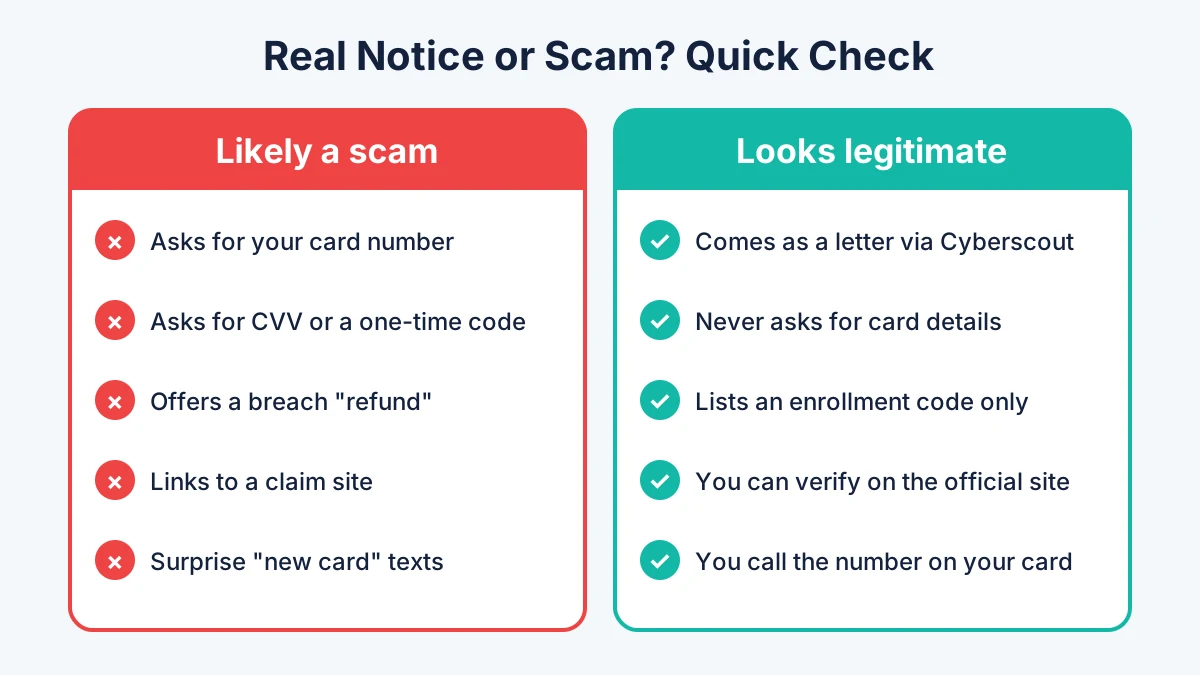
The biggest follow-up risk from the Cleverbridge data breach is phishing. Criminals often contact breach victims pretending to be the company, a bank or a “refund department,” hoping to collect the rest of your details.
Cleverbridge states plainly: “Cleverbridge will never ask you for your card details, passwords, or security codes.” Treat any message asking for them as a scam.
Watch for:
- Fake refund emails claiming you’re owed money from the breach and asking you to “verify” your card.
- Calls from “your bank’s fraud team” asking for a one-time code. Real banks never ask you to read out a code.
- Fake class action sign-up sites that ask for full card numbers or Social Security numbers.
- Texts with tracking links about a “replacement card” you didn’t order.
If you already clicked a suspicious link, follow our guide on what to do after clicking a phishing link. For other recent incidents and how they were handled, see our Who Gives A Crap data breach guide.
Is it safe to keep buying from companies that use Cleverbridge?
Yes, with sensible precautions. After the Cleverbridge data breach, the company says its systems were restored on November 4 and it notified payment card networks and authorities. Paying with a virtual card number, Apple Pay, Google Pay or PayPal where offered keeps your real card number away from the checkout.
Cleverbridge data breach FAQ
Is the Cleverbridge email or letter real?
Real notices began arriving on November 20, 2026, and are sent through TransUnion’s Cyberscout service. A genuine letter will not ask for your card number, password or security code. If in doubt, don’t click links; go to Cleverbridge’s incident update page by typing its website address yourself.
Was my CVV stolen?
Possibly. Cleverbridge says CVV data was included “in a minority of cases.” Notices described card numbers, expiry dates and CVV or CVC codes. Because you can’t easily confirm which group you’re in, the safe choice is to ask your card issuer for a replacement card with a new number and code.
How many people were affected?
As of November 24, 2026, Cleverbridge has not published a number. No state attorney general filing with a count has been found yet either. The number may appear later in regulatory filings, so check back for updates to this article.
Which companies’ customers were affected?
Cleverbridge has not named them. Malwarebytes lists Cleverbridge as one of its card processors, and Cleverbridge’s client list includes software firms such as Red Hat, SUSE and Parallels. None of these has been confirmed by Cleverbridge as affected, so rely on your own letter and statements.
Should I cancel my card?
Yes, if you used it for a purchase processed by Cleverbridge. Ask your bank to cancel and reissue it rather than only “locking” it, because the exposed number and CVV stay valid until the card is replaced. Then update any subscriptions that charge that card.
Do I need to freeze my credit?
It’s optional. Stolen card data alone can’t be used to open new credit in your name. A freeze is free and quick, though, and it protects you if later findings show more personal data was taken. You can lift it whenever you need to apply for credit.
Can I join a Cleverbridge class action lawsuit?
As of November 22, 2026, no class action or settlement had been reported, although law firms have started looking into the case. If one is filed, you’ll usually be contacted or can file a claim online. Never pay a fee or share full card numbers to join.
The bottom line on the Cleverbridge data breach
The Cleverbridge data breach exposed card numbers, expiry dates and, for some people, CVV codes from software and subscription purchases. If you got a letter or see Cleverbridge charges on your statement, replace the card, update your subscriptions and treat any call or email asking for card details as a scam. Doing those three things today removes most of the risk.
