
Black Friday scams are fake deals, lookalike stores, delivery texts and phony support numbers that trick holiday shoppers into paying for goods that never arrive or handing over card details. In 2026, Black Friday falls on November 27 and Cyber Monday on November 30, so the warnings are already spreading.
The good news: almost all Black Friday scams this season follows a few patterns you can learn in ten minutes. This guide shows the eight tricks being reported right now, a quick checklist to vet any deal, and exactly what to do if you already paid.
Contents
- What are Black Friday scams?
- Why scams spike in November 2026
- 8 Black Friday scams to watch for in 2026
- How to check a deal in 60 seconds
- How to avoid Black Friday scams: 9 safe-shopping habits
- What to do if you fell for a scam
- FAQ
What are Black Friday scams?
Black Friday scams are frauds timed to the holiday sales rush that use fake discounts, fake stores or fake messages to steal money or personal data. They work because shoppers expect big price cuts, act fast and get dozens of real order and shipping emails at the same time.
Most fall into three groups:
- Fake sellers: the most common Black Friday scams, run through websites or social media shops that take payment and ship nothing, or ship a cheap knockoff.
- Fake messages: texts, emails and calls posing as a retailer, bank or delivery company to grab your login, card number or a “redelivery fee.”
- Payment tricks: requests to pay by gift card, wire, Zelle or crypto, which are hard or impossible to reverse.
Why scams spike in November 2026
Black Friday scams spike now because more money is moving online than at any other time of year. Adobe forecasts US online holiday spending of $275.1 billion from November 1 to December 31, 2026, including $12.9 billion on Black Friday and $15.1 billion on Cyber Monday (Adobe, September 2026).
Fraud numbers are also at record highs. The Federal Trade Commission says Americans reported losing $15.9 billion to fraud in 2025, up from $12.5 billion in 2024, and text messages were the most common way scammers made first contact (FTC, March 2026).
Social media is a major entry point for Black Friday scams. FTC data released in April 2026 shows people lost $2.1 billion to scams that started on social media in 2025, and shopping scams were the most reported type there (FTC). The FBI’s 2025 Internet Crime Report logged 56,478 non-payment and non-delivery complaints, the category where you pay and never get the item (FBI IC3).
8 Black Friday scams to watch for in 2026
These are the eight Black Friday scams consumer groups and news outlets are flagging this month. Each one has a tell you can spot before you pay.
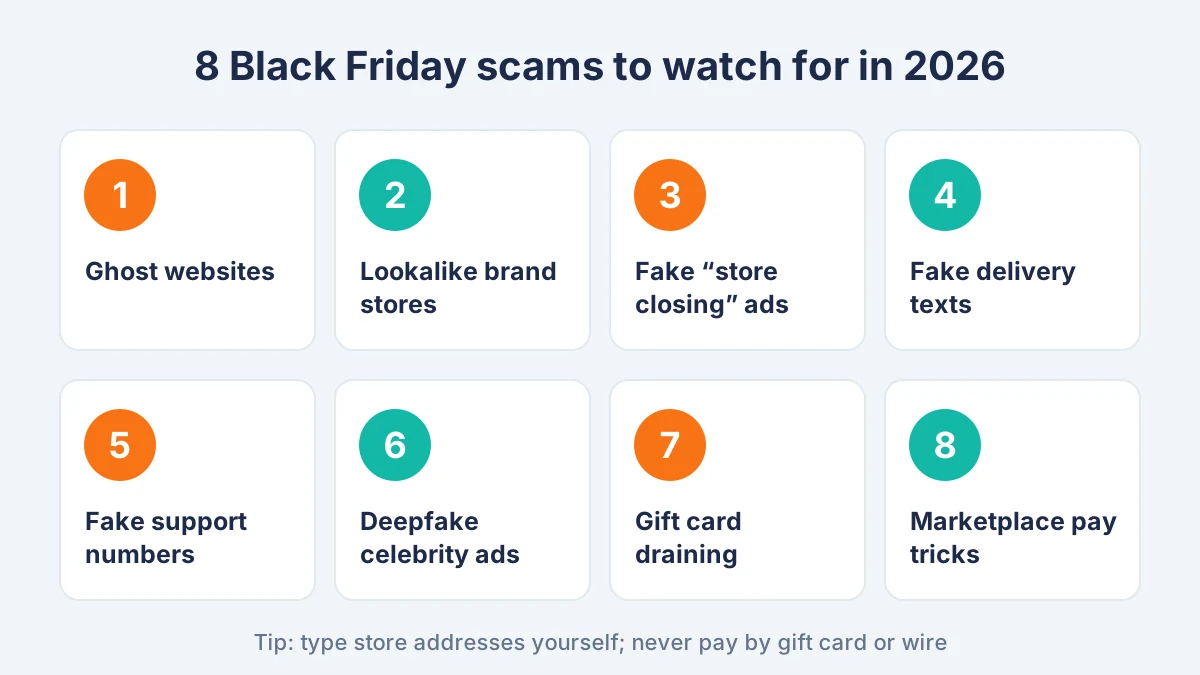
1. Ghost websites from social media ads
A ghost website is a store built to look real for a few weeks, collect payments, then vanish. An InvestigateTV report published November 12, 2026 warned that fake ads on social media are steering shoppers to these sites (KKTV/InvestigateTV).
Tell: a brand-new domain, prices 70–90% below every other store, and no real contact address.
2. Lookalike brand stores
Scammers copy a famous brand’s logo, photos and layout on a domain that is one letter off or adds “outlet” or “sale.” NordVPN researchers said on November 4, 2026 that they found more than 10,000 fake stores impersonating 166 fashion brands, and that some were even suggested by AI chatbots (NordVPN via Telecom Ramblings).
Tell: check the address bar, not the logo. Type the brand’s address yourself.
3. “Store closing” and “final clearance” ads
These ads claim a beloved local shop is closing and selling everything cheaply. The story is invented to explain the low prices and create urgency.
Tell: search the store name plus “closing.” A real closure gets local news coverage.
4. Fake delivery and “problem with your order” texts
You get a text saying a package is on hold and you need to confirm an address or pay a small fee. The link leads to a page that steals card details. The Better Business Bureau says text scams made up 14.9% of its Scam Tracker reports in 2025, up from 9.8% (BBB).
Tell: carriers do not text you for redelivery fees. Track orders only in the store’s app or the carrier’s official site. Our guide on how to stop spam texts shows how to filter these.
5. Fake customer service numbers
Scammers buy sponsored search ads that show a phone number for a big retailer. When you call about an order, the “agent” asks for your card number or remote access to your computer.
Tell: get support numbers only from the official app, your order confirmation or the retailer’s website.
6. Deepfake celebrity deal ads
AI-generated video of a celebrity or influencer “giving away” products or promoting a deal. Identity firm Veriff warned on November 12, 2026 about deepfake ads and cloned-voice “order on hold” calls aimed at holiday shoppers (Manila Times/GlobeNewswire).
Tell: no real celebrity sells discounted gadgets through a video ad that asks for a “shipping fee.” Read more on AI voice cloning scam calls.
7. Gift card draining
Not all Black Friday scams happen online. Criminals copy the numbers off gift cards on store racks and wait for someone to load them, then spend the balance first. The BBB lists gift card draining among its top holiday scams.
Tell: a torn or resealed package, or a PIN area that is scratched. Buy cards from behind the counter or directly from the brand’s site.
8. Too-good-to-be-true marketplace sellers
On Facebook Marketplace and similar sites, sellers list the season’s hot gadgets or game consoles at low prices and ask for payment by Zelle, Cash App or gift card “to hold it.”
Tell: any request to pay outside the platform’s checkout. Those payments have almost no protection.
How to check a deal in 60 seconds
You can catch most Black Friday scams in a minute by checking the address, the price and the payment page before you enter card details. Use this quick test:
| Check | Safe sign | Red flag |
|---|---|---|
| Web address | Official brand domain you typed | Extra words, odd spelling, new domain |
| Price | Close to other big retailers | 70%+ below everyone else |
| Contact info | Real address, phone, return policy | Only a web form or Gmail address |
| Payment | Credit card, PayPal, Apple/Google Pay | Gift card, wire, Zelle, crypto only |
| Reviews | Years of reviews off the site | No reviews, or “scam” results in search |
Search the store’s name with the word “scam” or “reviews,” which is the same tip consumer experts gave InvestigateTV this week. For a deeper check, follow our 12-point guide on how to tell if a website is legit.
[ADD PERSONAL EXPERIENCE: Describe a real fake deal ad or delivery text you received this season, with a redacted screenshot, and the exact clue that gave it away.]
How to avoid Black Friday scams: 9 safe-shopping habits
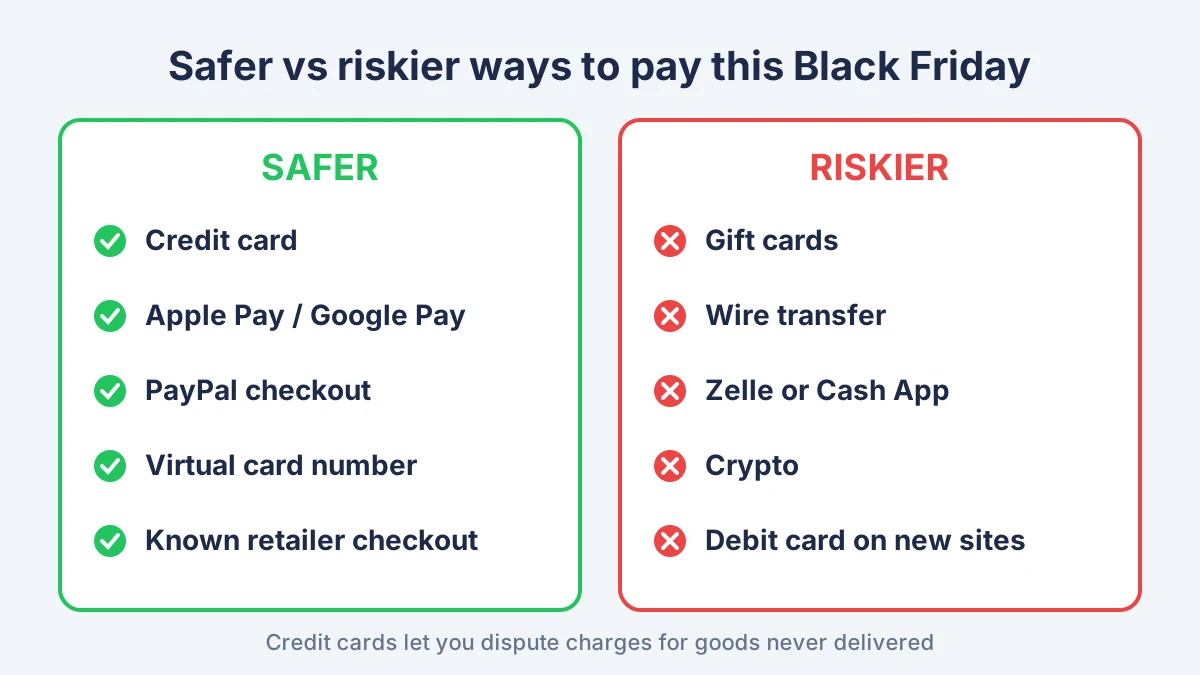
The safest way to avoid Black Friday scams is to shop from stores you reach yourself and pay with a method that lets you dispute charges. These nine habits block nearly every trick above, online or in store.
- Type the address or use the official app. Do not click deal links in ads, texts or emails.
- Pay with a credit card or a wallet like Apple Pay or Google Pay. Credit cards give you dispute rights under federal law; debit cards pull directly from your bank.
- Use a virtual card number if your bank or card offers one, so a leaked number can be closed without replacing your main card.
- Turn on purchase alerts in your banking app so you see every charge within seconds.
- Never pay by gift card, wire, crypto or Zelle to a seller you do not know.
- Track packages only in official apps. Ignore texts with links about missed deliveries.
- Turn on two-factor authentication for Amazon, PayPal, your email and your bank. Here is how to turn on two-factor authentication on each.
- Screenshot your order and confirmation email, including the seller’s address and return policy.
- Slow down. Countdown timers and “only 2 left” banners exist to rush you. A real deal will still be there after a two-minute check.
What to do if you fell for a scam
If you paid a scam store or typed your card into a fake page, call your card issuer right away, then report the scam. Acting within days gives you the best chance of getting money back.
- Call your bank or card issuer using the number on the back of your card. Ask them to block the card and dispute the charge.
- Dispute in writing. Under the Fair Credit Billing Act, your letter must reach the card issuer within 60 days after the first bill with the charge was sent, and it covers goods not delivered as agreed (FTC).
- Change passwords on any account you entered on the fake page, and turn on two-factor authentication.
- Report it to the FTC at ReportFraud.ftc.gov and to the FBI at IC3.gov.
- If you shared your Social Security number or ID, get a recovery plan at IdentityTheft.gov.
- If you clicked a link in a text or email, follow our step-by-step guide on what to do after clicking a phishing link.
Rules and figures here are current as of November 15, 2026. New Black Friday scams appear every season, so check the FTC’s consumer alerts before big shopping days.
FAQ
What are the most common Black Friday scams?
The most common Black Friday scams are fake online stores promoted through social media ads, lookalike brand websites, fake delivery texts asking for a fee, phony customer service numbers in search ads, and marketplace sellers who demand gift cards or Zelle. All of them aim to get your payment or card details.
How can I tell if a Black Friday deal is fake?
Compare the price with two or three big retailers. If it is 70% or more below everyone else, be suspicious. Check that the web address is the brand’s real domain, look for a physical address and return policy, and search the store’s name with “scam.” Avoid any site that only takes gift cards, wires or crypto.
Is it safe to shop from Facebook or Instagram ads?
It can be, but social media ads are where many fake stores start. FTC data shows shopping scams were the most reported scam type on social media in 2025. Instead of tapping the ad, search for the brand yourself, go to its official website, and confirm the same deal exists there.
Can I get my money back after a Black Friday scam?
Often, if you paid by credit card. The Fair Credit Billing Act lets you dispute charges for goods not delivered, as long as your written dispute reaches the issuer within 60 days of the statement. PayPal and some wallets have buyer protection too. Gift card, wire and crypto payments are very hard to recover.
Are delivery texts from USPS, UPS or FedEx real?
Most unexpected delivery texts with a link are scams, especially ones asking you to pay a small fee or confirm an address. Carriers do not charge redelivery fees by text. Track packages by typing the tracking number into the carrier’s official website or using the retailer’s app, and delete the message.
Where do I report a Black Friday scam?
Report it to the Federal Trade Commission at ReportFraud.ftc.gov and to the FBI’s Internet Crime Complaint Center at IC3.gov. Also tell your bank or card issuer right away. If the scam happened on a social platform or marketplace, report the ad or seller there so it can be removed for other shoppers.
Is paying with a debit card safe on Black Friday?
A debit card is riskier than a credit card because money leaves your bank account immediately and federal protections differ. If a scammer gets the number, you may be without that cash while the bank investigates. Use a credit card, a digital wallet like Apple Pay or Google Pay, or a virtual card number instead.
The bottom line
Black Friday scams in 2026 rely on speed, fake ads and fake messages, not clever hacking. Type store addresses yourself, pay with a credit card or digital wallet, ignore delivery texts with links, and take one minute to check any deal that looks unusually cheap. If something goes wrong, call your card issuer the same day and report it to the FTC.
