
The Who Gives A Crap data breach exposed customers’ names, email addresses, phone numbers, mailing addresses and the total amount they’ve spent with the company, after hackers got into an unnamed US-based marketing software provider. Payment details, order details and passwords were not involved, according to the company. If you shop with the eco-friendly toilet paper brand in the US, UK or Australia, the main risk now is convincing phishing, not stolen cards.
The company emailed affected customers late on Saturday, November 7, 2026. Below is what’s confirmed, what’s still unknown, and a short checklist you can finish in about 15 minutes.
Facts in this article are current as of November 9, 2026. Details such as the vendor’s name and the number of affected customers had not been released and may change.
What happened in the Who Gives A Crap data breach?
A third-party marketing software provider used by Who Gives A Crap (WGAC) was accessed without authorization between October 30 and November 1, 2026, and some WGAC customer records stored in that tool were exposed. WGAC’s own systems and customer accounts were not directly accessed, the company said.
A third-party breach (also called a supply-chain or vendor breach) is when attackers compromise a company’s service provider rather than the company itself. Retail brands share customer lists with marketing tools for emails and promotions, so a hack at one vendor can expose data from many brands at once.
According to ABC News, co-founder and CEO Simon Griffiths said the company was told about the incident on Friday, November 6, and notified customers the next day. WGAC said it disconnected the provider from its systems and changed access credentials. It also said it will engage with regulators as required.
What data was exposed (and what wasn’t)?
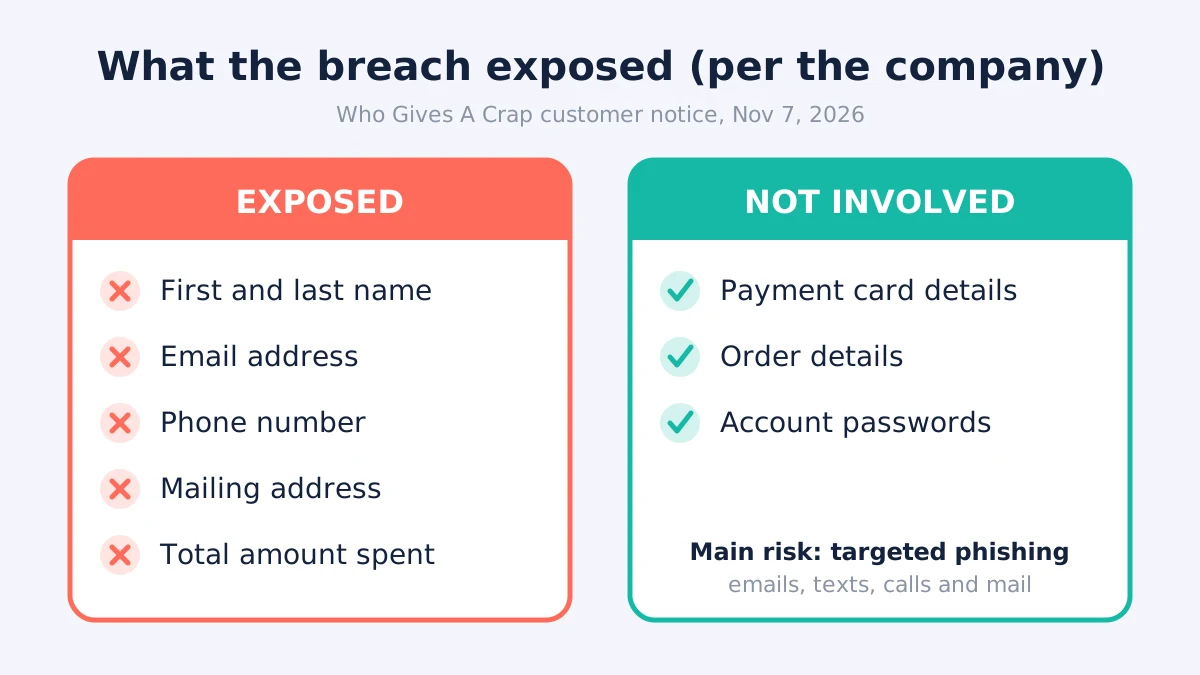
Exposed data includes first and last name, email address, phone number, mailing address and your total lifetime spend with WGAC. The company says no payment card details, order details or passwords were involved. Both ABC News and Cyber Daily report the same list.
| Data type | Exposed? |
|---|---|
| First and last name | Yes |
| Email address | Yes |
| Phone number | Yes |
| Mailing address | Yes |
| Total amount spent with WGAC | Yes |
| Payment card details | No (per company) |
| Order details | No (per company) |
| Account passwords | No (per company) |
| Social Security number | Not collected or mentioned |
Two things are still unknown as of November 9, 2026: whether the attackers copied or downloaded the data, and how many customers were affected. WGAC said it had no evidence of misuse so far, and no hacking group had publicly claimed the attack, per SECNEWS.
Why “total amount spent” matters
Your spend total looks harmless, but it helps scammers write believable messages. A fake email that says “As one of our top customers who has spent \$214 with us, you’re owed a refund” feels far more real than a generic offer. It also lets criminals pick out loyal, higher-spending customers as targets.
Who Gives A Crap data breach timeline
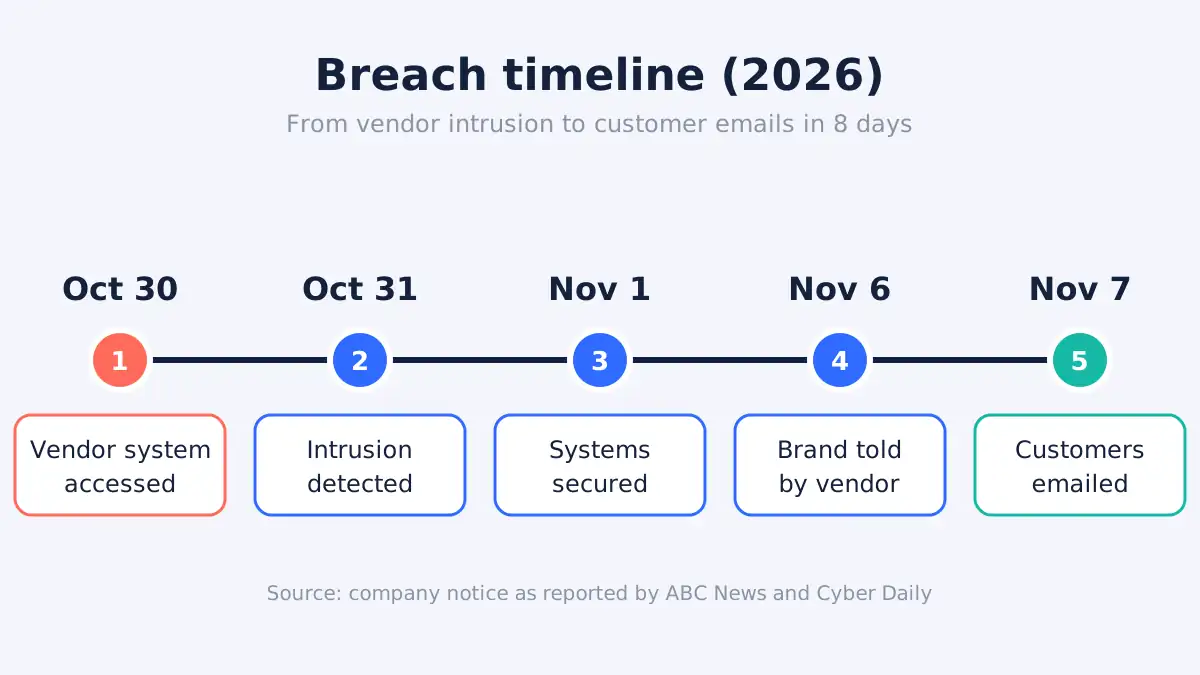
The vendor breach started on October 30, 2026, and customers heard about it eight days later. Dates below come from WGAC’s notice as reported by ABC News, Cyber Daily and SECNEWS.
| Date (2026) | Event |
|---|---|
| Oct 30 | Unauthorized access to the marketing provider begins |
| Oct 31 | Provider detects the intrusion |
| Nov 1 | Affected systems secured |
| Nov 6 | Provider informs Who Gives A Crap |
| Nov 7 | WGAC starts emailing affected customers |
| Nov 8 | News coverage in Australia, the UK and the US |
Were US customers affected by the Who Gives A Crap data breach?
Yes. WGAC says customers in the United States, United Kingdom and Australia were affected. Canadian customers’ data appears not to have been involved, according to ABC News and Cyber Daily. The company has not said how many people in each country received a notice.
If you’re a US customer and haven’t received an email, check your spam folder. If there’s still nothing, assume your contact details could be in the affected set and follow the steps below anyway. They’re good habits and cost nothing.
[ADD PERSONAL EXPERIENCE: If you or a reader received the WGAC notice, describe the email (sender address, subject line, whether it contained links) so readers can compare it with what they got. Redact anything personal.]
What to do now: 6 steps for WGAC customers
You don’t need to cancel cards or panic. The goal is to make sure a scammer who has your name, contact details and spend history can’t trick you. These steps follow guidance from the FTC.
1. Treat any “WGAC” message with links as suspicious
Don’t click links or call numbers in unexpected emails, texts or letters that mention Who Gives A Crap, refunds or “account problems.” The company itself urged customers to verify any communication claiming to be from WGAC.
2. Go to the company directly
Type the US store address yourself (us.whogivesacrap.org) or use a bookmark you already have. Sign in there to check your subscription or orders. Never sign in through a link in a message.
3. Change reused passwords
WGAC says passwords weren’t involved, so changing your WGAC password is optional. But if you use the same password anywhere else, change it on those sites, starting with email and banking. A password manager makes this easier.
4. Turn on two-factor authentication on your email
Your email address is now in more hands. Turning on two-factor authentication (2FA) on your email account means a phished password alone won’t get a criminal in. The FTC lists multi-factor authentication among its core protections against phishing.
5. Watch your card and bank statements
Your card details weren’t exposed. Still, phishing messages often try to get you to “re-enter” payment info. Check statements over the next few weeks and report anything unfamiliar to your card issuer using the number on the back of your card.
6. Report phishing you receive
In the US, forward scam texts to 7726 (SPAM), forward phishing emails to reportphishing@apwg.org, and report fraud attempts at ReportFraud.ftc.gov. Reports help carriers and the FTC block campaigns faster.
Scams to expect after the breach
Expect phishing that uses your real name, address and order history to look legitimate. Here are the most likely formats, based on how criminals typically use this kind of data.
Email phishing
Fake “refund,” “loyalty reward” or “subscription failed, update your card” emails that copy WGAC’s playful branding. The FTC notes that legitimate companies won’t email or text a link to update your payment information.
Text messages (smishing)
Short texts like “Your Who Gives A Crap delivery is on hold. Confirm your address” with a shortened link. Delivery-problem texts are one of the most common scam formats in the US.
Phone calls
Callers who know your name and address may claim to be from WGAC’s “fraud team” and ask for a one-time code or card number to “secure your account.” Hang up and contact the company through its website.
Physical mail
Because mailing addresses were exposed, watch for letters offering “breach compensation” that ask you to call a number or visit a website. Verify any such offer on the official site first.
Red flags at a glance:
- Urgent deadlines (“respond within 24 hours”)
- Requests for card numbers, bank details or one-time codes
- Links that don’t go to whogivesacrap.org
- Offers of compensation or refunds you didn’t request
- Payment by gift card, crypto or wire transfer
Do you need a credit freeze?
A credit freeze is optional here, because no Social Security numbers or financial account numbers were exposed. A credit freeze blocks lenders from viewing your credit report, which stops most new-account fraud. The FTC says a freeze is free, doesn’t affect your credit score, and is even more important when your Social Security number is exposed.
If you want one anyway, you need to contact all three bureaus: Equifax, Experian and TransUnion. It lasts until you lift it. If you’re unsure whether your information has been misused, the FTC’s IdentityTheft.gov/databreach page walks you through next steps.
Is it safe to keep ordering from Who Gives A Crap?
Based on what the company has disclosed, ordering through the official website carries no new risk, because its own systems and payment data weren’t breached. WGAC says it cut off the affected vendor. The bigger question is how retailers vet the tools that hold customer data, and the company has not yet named the provider or said whether it will keep using it.
If you’d rather limit exposure, you can unsubscribe from marketing emails. That reduces how often your details sit in marketing platforms, though it won’t remove data already shared.
FAQ
Was my credit card stolen in the Who Gives A Crap data breach?
No, according to the company. WGAC says payment details, order details and passwords were not involved. The exposed data was names, emails, phone numbers, mailing addresses and total spend. Still, watch for phishing messages asking you to “update” your card, and check statements over the next few weeks.
Do I need to change my Who Gives A Crap password?
It isn’t required, because WGAC says passwords weren’t exposed and customer accounts weren’t accessed directly. However, if you reused that password on any other site, change it there now, starting with your email and bank. Using a unique password for every account limits the damage from future breaches.
Which company was hacked in the Who Gives A Crap data breach?
WGAC has only described it as a US-based marketing software provider. As of November 9, 2026, neither the company nor news outlets had named the vendor. If the name is released, other brands using the same platform may also announce breaches, so watch for similar notices from retailers you use.
Were Canadian customers affected?
Canadian customers’ data appears not to have been involved, according to ABC News and Cyber Daily. The company has confirmed that customers in Australia, the UK and the US were affected. It has not explained why Canada was excluded or how many customers in each country were notified.
Should I freeze my credit after the Who Gives A Crap data breach?
It’s optional. The FTC says a credit freeze is free and always a good idea, but it matters most when a Social Security number is exposed, which didn’t happen here. A freeze won’t stop phishing emails or texts, so your first priority is spotting fake messages that use your details.
How can I tell if an email from Who Gives A Crap is real?
Don’t rely on the sender name or logo, which are easy to fake. Instead, open the website yourself by typing the address and check your account there. Be wary of any message that pushes urgency, offers unexpected refunds, or asks for card details or one-time codes. When in doubt, contact customer support through the website.
Bottom line
The Who Gives A Crap data breach didn’t expose cards or passwords, but it gave scammers enough real detail to send convincing fake messages. Spend 15 minutes today: change any reused passwords, turn on 2FA for your email, and agree with yourself never to click a “WGAC” link in a message. Then report any phishing you get to 7726 or ReportFraud.ftc.gov.
We’ll update this article if the company names the vendor or shares how many customers were affected.
